

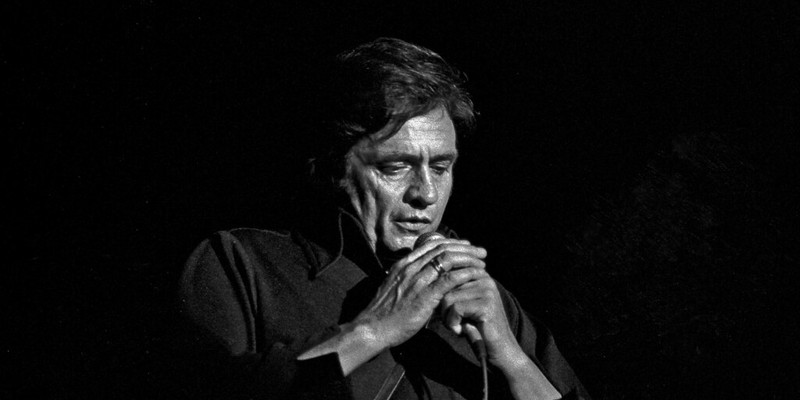
Johnny Cash built his legend singing about outlaws, hard time, and men who had reached the end of the line. But in 1969, the Man in Black took his prison songs into the real world — and confronted a system that had become a national disgrace.
On April 10, 1969, Cash stepped onto a makeshift stage at Arkansas’s Cummins Prison Farm in front of nearly 900 inmates. He wasn’t there simply to entertain. He had a message for the politicians watching from the back.
“There’s a lot of things that need changing here, Mr. Legislator Man.”
It was an extraordinary moment for a country star who was then riding a wave of enormous commercial success. And it revealed something about Cash that went beyond his image as country music’s favorite outlaw.
He believed that even guilty men were still human beings — and that a society had a duty to treat them accordingly.
In the 1960s, Arkansas operated its prison farms under a system that bore an unsettling resemblance to the plantation era. Inmates worked the fields under armed supervision, while other prisoners known as trustees were entrusted with enforcing discipline.
The abuses were notorious. Beatings, corruption, and allegations of torture helped turn Cummins and Tucker prison farms into symbols of a deeply broken institution. One particularly infamous device, known as the “Tucker telephone,” was used to administer electric shocks to prisoners.
A suppressed state police investigation and a subsequent scandal involving alleged murders at Cummins brought national attention to Arkansas’s prisons.
The crisis confronted Winthrop Rockefeller, the state’s Republican governor and a member of the prominent Rockefeller family. He wanted reform. Cash, an Arkansas native who had grown up poor during the Great Depression, was prepared to help.
Cash knew poverty firsthand. As a boy, he had picked cotton and watched his family struggle through the Depression. His songs about prison life were so convincing that many people assumed he had served serious time himself. In reality, he had experienced brief jail stays, not a lengthy prison sentence.
But he understood the desperation, temptation, and human frailty behind the bars.
In 1968, Cash agreed to perform in support of Rockefeller’s campaign on the condition that the governor address the prison system’s abuses. It was a remarkable arrangement: a country music superstar using his celebrity to push a politician toward meaningful change.
The following spring, Cash returned to Arkansas for the Cummins concert. He ate lunch with inmates, visited death row, and reserved the front-row seats for prisoners rather than government officials.
He performed familiar hits, including “Folsom Prison Blues” and “I Walk the Line,” alongside a song written specifically for the occasion, “When I Get Out of Cummins.” Its message challenged officials to prove that rehabilitation was more than a political slogan.
The inmates responded by crowning him the “King of Cummins” and presenting him with an honorary life sentence.
Cash’s own explanation was simpler than any political speech.
“I think these men are very, very human, and some people ought to be more careful about how they treat human beings.”
Cash’s intervention was about more than prison conditions. His evangelical Christian faith informed his belief that punishment should leave room for redemption.
He donated $10,000 toward the construction of chapels at Cummins and Tucker. The Tucker Chapel, known as the “Island of Hope,” opened in 1969, offering prisoners a dedicated place for worship.
The legal system was also moving toward reform. Federal Judge J. Smith Henley ruled against unconstitutional conditions at Cummins in Holt v. Sarver. In 1970, he declared Arkansas’s entire state prison system unconstitutional, a decision affirmed by the Eighth Circuit Court of Appeals in 1971.
Arkansas eventually abandoned its old self-funding prison plantation model, with the legislature voting in 1970 to fund the prisons through taxpayer dollars.
Cash was not the sole architect of these changes. Judges, reformers, investigators, and others played essential roles. But his advocacy helped bring attention and public pressure to a system that desperately needed both.
Cash didn’t stop at the Arkansas state line. In 1972, he testified before a Senate subcommittee on national penitentiaries, arguing that prisoners had to be treated as human beings if society expected them to behave like human beings.
He also met with President Richard Nixon to discuss prison reform.
The story was not a fairy tale. The man whose parole Cash had helped secure, former inmate and songwriter Glenn Shirley, continued to struggle with personal demons and died by suicide in 1978. Arkansas itself would not reach full federal compliance with the court’s reform requirements until 1982.
Redemption was neither quick nor guaranteed. Cash knew that better than most.
Johnny Cash was no stranger to songs about crime, violence, and consequences. He never needed to pretend that wrongdoing did not exist to believe that justice had to mean something more than cruelty.
His intervention in Arkansas offers a powerful reminder that law and order and human dignity do not have to be enemies. A prison can hold people accountable without abandoning the belief that they may still change.
That is not weakness. It is a conviction rooted in personal responsibility, faith, and the idea that every human being possesses an inherent worth.
Cash could have enjoyed his fame, sung his hits, and left the politicians to their business. Instead, he went home, confronted an ugly reality, and used his platform to demand better.
One man. One guitar. One handshake deal. And a prison system that would never be the same.
Watch the full story on Baste Records’ YouTube channel to discover how Johnny Cash became an unlikely force in one of America’s most consequential prison reform battles. Like, subscribe, and join the conversation: What does real justice look like when accountability and redemption collide?
"Johnny Cash 2209720084" by Heinrich Klaffs is licensed under CC BY-NC-SA 2.0.
