

Before comedy became a minefield of rules, Don Rickles proved that the most powerful man in the room could still be the butt of the joke.
Don Rickles had a gift for making the untouchable look human.
Frank Sinatra was one of the biggest stars in America. Roy Rogers was the King of the Cowboys. Glen Campbell was a country music superstar. And Rickles, a sharp-tongued Navy veteran from Queens, New York, made a career out of treating all of them exactly the same.
He insulted the powerful, mocked the pretentious and turned the rules of show business upside down. Somehow, the biggest names in entertainment didn't just tolerate him. They loved him.
That story is at the heart of a new Baste Records video exploring Rickles' remarkable connections to Sinatra, Rogers and Campbell, and why his brand of fearless comedy belongs in the story of American popular culture.
Rickles was born in 1926 and served in the United States Navy during World War II. After returning home, he tried to establish himself as a serious actor. Instead, he discovered that audiences responded most enthusiastically when he fired back at hecklers. The insults became his signature, and a legendary career followed.
His approach was simple. Nobody was too famous to take a joke.
In 1957, Rickles encountered Sinatra at a Hollywood nightclub and delivered the kind of insult that could have ended another comedian's career.
After joking about Sinatra's movie, Rickles told the superstar to make himself at home and hit somebody.
Sinatra laughed.
The encounter helped launch a friendship that would become one of show business's great unlikely partnerships. Sinatra was surrounded by admirers, but Rickles offered something different: a man who wasn't afraid to tell him to his face what everyone else might only whisper behind his back.
Years later, Sinatra told the story of Rickles' audacious sense of humor on The Tonight Show Starring Johnny Carson. Rickles even appeared during the broadcast, needling his famous friend as only he could.
It was a reminder of a simpler era in American entertainment, when confidence meant being able to take a joke as readily as you could deliver one.
Roy Rogers and Glen Campbell Shared the Stage With the Merchant of Venom
Rickles' reach extended far beyond Las Vegas nightclubs.
In a 1969 appearance on The Dean Martin Show, he shared a Western-themed comedy sketch with Roy Rogers. When Rogers stumbled over a line, Rickles seized the opportunity to roast the legendary cowboy, drawing laughter from the audience.
It was an unlikely pairing, but it captured something wonderful about the old variety-show era. Hollywood stars, country performers and comedians could share the same stage without having to fit into separate cultural boxes.
Rickles also appeared on The Glen Campbell Goodtime Hour in 1971, alongside Campbell, folk legend Burl Ives and singer Anne Murray. He played multiple comic characters, bringing his unpredictable energy into a program built around music, humor and entertainment for the whole family.
This was television when Americans could turn on the set and discover an unexpected combination of talent. Country music wasn't quarantined from comedy, and comedy didn't need to abandon its edge to reach a national audience.
That spirit deserves to be remembered.
What made Rickles so effective wasn't simply that he was insulting. It was that his comedy could cross boundaries of fame, status and background.
Sinatra got it. Rogers got it. Campbell got it. So did the ordinary people sitting in the audience.
In Rickles' world, a superstar and a stranger could both become the target of the same joke. Nobody was automatically entitled to special treatment.
That is part of what makes his comedy feel so distinctly American. The country has always had a tradition of irreverence toward authority, from frontier storytellers and political satirists to country comedians who could puncture a person's ego with a single well-timed line.
Country music understands this instinct. Its best performers have long known that audiences value authenticity over pretension, and that a little self-deprecation can go a long way.
Rickles brought that same fearless spirit to the stage. He worked without a safety net, read the room and trusted his audience to understand the difference between a joke and genuine hostility.
His success wasn't built on carefully managed celebrity worship. It was built on nerve, timing and the willingness to risk a room full of people for a laugh.
There is another important part of Rickles' story. Before he became a fixture of American entertainment, he served his country during World War II.
He returned home and built his career the hard way, developing a style that couldn't easily be manufactured or replicated. His longevity was a testament to his talent and his ability to connect with audiences across generations.
In 2025, his 1968 live album Hello, Dummy! was inducted into the Library of Congress's National Recording Registry, recognizing its cultural and historical significance.
It was a fitting recognition for a performer whose impact went well beyond the nightclub.
The old variety-show era is gone, and the cultural landscape has changed dramatically. But Rickles' story reminds us of something worth preserving: an America where country singers, movie stars, war veterans and wisecracking outsiders could all share the same stage.
Roy Rogers could be the King of the Cowboys. Glen Campbell could command a television audience with his music. Frank Sinatra could be one of the most powerful men in entertainment.
And Don Rickles could still walk into the room and tell them they were idiots.
That wasn't a rejection of American greatness. It was a celebration of a culture confident enough to laugh at itself.
At Baste Records, that independent spirit is worth remembering. Because sometimes the most American thing you can do is stand in front of a powerful man, look him in the eye and refuse to be intimidated.
And if you're Don Rickles, you might as well get a laugh out of it.
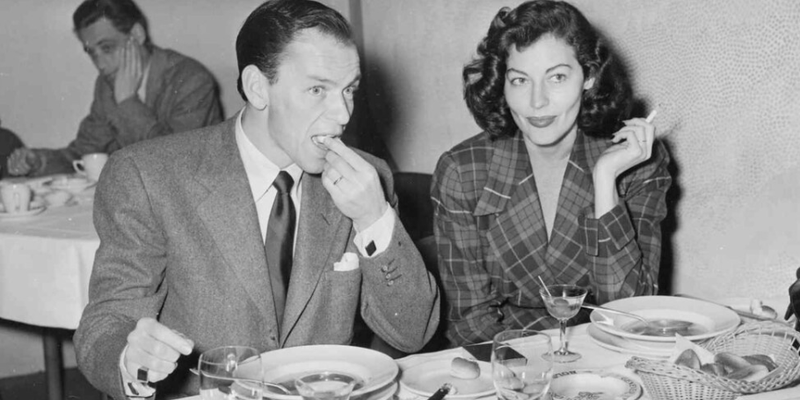
"12-13-1951_10109 Frank Sinatra en Ava Gardner" by IISG is licensed under CC BY-SA 2.0.
