

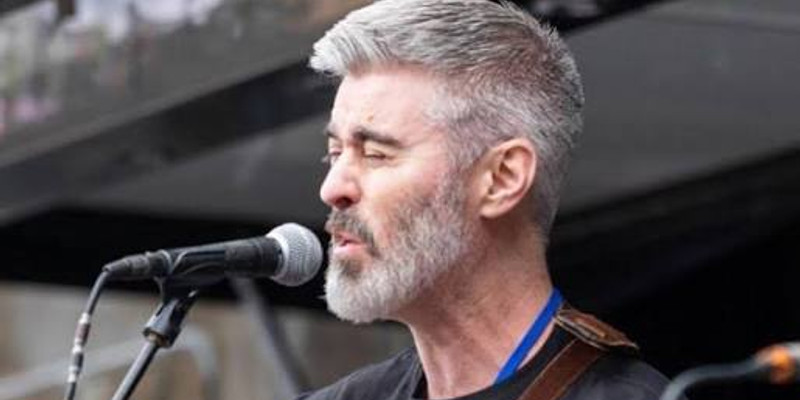
There is something unusual happening on Mike Cavanaugh's new album, Closer to a Christian Nation.
Imagine the introspective songwriting tradition of Nick Drake and Elliott Smith, but instead of writing about heartbreak, alienation, and personal demons, the songwriter is wrestling with the spiritual and political condition of America.
It's an unexpected combination. And that's precisely what makes it interesting.
Released by Baste Records, Closer to a Christian Nation is an unapologetically Christian, politically conservative indie-folk record that refuses to separate music from the cultural moment in which it exists.
Cavanaugh isn't interested in playing it safe. He's interested in saying something.
The album opens with "Revival," a straightforward plea for spiritual renewal that quickly expands beyond personal faith into a vision for the country itself. Churches overflowing. Leaders finding their courage. Christ on the lips of every American.
It's an old-fashioned idea in a decidedly unfashionable package.
And then things get considerably more confrontational.
"The Spirit of the Age" takes aim at America's foreign-policy priorities, the treatment of Appalachia, and the government's response to communities devastated by disaster. "Christianity Today" turns its attention toward the contradictions of modern religious and conservative institutions, questioning a culture that seems increasingly comfortable with everything except an unapologetic declaration of Christian belief.
On "A YouTube Channel and a Camera Phone," Cavanaugh takes inspiration from independent journalist Nick Shirley and the changing relationship between ordinary Americans, independent media, and institutional power.
The message is simple: you don't need a television network to tell a story anymore.
You need a camera, a platform, and the willingness to ask questions.
That same distrust of established narratives runs through "I Don't Recognize My Country Anymore," a portrait of national alienation that captures the feeling of watching a familiar country become increasingly unfamiliar.
But the album's most emotionally significant moment may be "The Voice of the Age."
Written around the assassination of Charlie Kirk, the song moves from grief and uncertainty toward faith and forgiveness. Its most striking image is that of a widow choosing forgiveness in the aftermath of unimaginable violence.
It's a difficult subject, and Cavanaugh doesn't attempt to make it comfortable.
That willingness to confront uncomfortable subjects is central to the record. "Heritage America," "Illegal Immigration," and "I'll Wait for You (My Lord)" tackle questions of national identity, immigration, race, religion, and the future of Western civilization. Some of the lyrics are deliberately provocative, and listeners will undoubtedly disagree with parts of the album's worldview.
But disagreement is not the same thing as irrelevance.
In fact, the record's refusal to conform is part of its identity.
What makes Closer to a Christian Nation particularly interesting is its relationship with the indie-folk tradition. The genre has produced some of the most intimate and emotionally compelling songwriting of the last several decades, but its cultural identity has often been associated with progressive politics and secular sensibilities.
Cavanaugh takes that tradition somewhere else.
He writes about Christ, the Church, national belonging, political disillusionment, and the possibility of religious revival. He isn't attempting to win approval from the cultural institutions that traditionally determine what is considered acceptable artistic expression.
He's making music from an entirely different set of convictions.
And that's worth paying attention to.
The title track, "Christian Nation," brings the record's central argument into focus. Cavanaugh isn't hiding the destination. He wants a country where Christian faith informs education, culture, music, and everyday life.
Whether listeners agree with that vision or not, the album makes one thing abundantly clear: there is an audience hungry for music that takes faith and cultural identity seriously.
Perhaps that's the most interesting thing about Closer to a Christian Nation.
At a time when so much popular music is built around carefully managed identities, approved opinions, and the avoidance of controversy, Cavanaugh has made a record that is comfortable being unpopular in the right rooms.
It is imperfect, provocative, sincere, and unmistakably its own thing.
America doesn't need another manufactured pop star telling us what we're supposed to think. It needs more independent artists willing to write about what they actually believe, even when those beliefs fall outside the cultural mainstream.
Mike Cavanaugh is making that music.
And perhaps the next great American indie-folk movement won't sound quite like the last one.
Purchase the album here: https://elasticstage.com/mikecavanaugh/releases/closer-to-a-christian-nation-album
